




What is a Good APR for Car Loans?
Purchasing a new or used vehicle typically means you take out a car loan. When going through the car-buying process, it’s important to know what the annual percentage rate (APR) is as this affects your payment amount. The APR is the amount you pay annually to borrow money, including fees, and then expressed as a percentage. It’s best to look at the APR instead of the interest rate because it better reflects what the loan will cost and the amount of money you will pay.
What Is an APR?
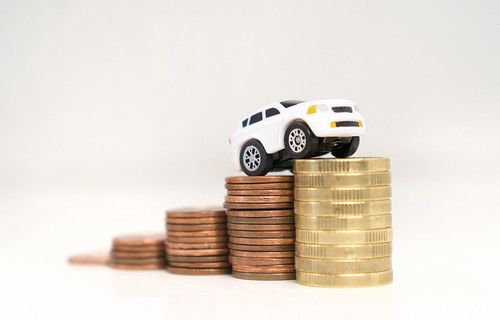
Image via Flickr by free pictures of money
When you borrow money in the form of a car loan from a financial institution, you receive the entire amount, although you don’t physically see the money. In return, you pay back the money plus interest over a specific amount of time. That time frame and the interest rate affect the monthly payment size.
If the APR and interest rate on the loan are different amounts, the APR is typically the higher number. That’s simply because the APR includes additional fees. These fees include protection plans such as gap insurance or tire protection plans, taxes applied to the purchase, the interest that accumulates before your first loan payment is due, and prepaid finance charges.
What’s the Difference Between APR and Interest Rate?
You might think the APR and the interest rate are the same, but that’s where you’re mistaken. The interest rate refers to how much you pay annually to borrow money minus the fees, whereas the APR includes fees. The Truth in Lending Act mandates that lenders must tell you the specifics about the terms, including the APR, before you agree to the loan. Since this is required, you can compare the APR of other lenders to make sure you’re getting the best deal. Just keep in mind that you’re comparing the APR and not interest rate.
Mathematically, both rates give you the same monthly payments and result in you paying the same amount for your vehicle. However, lenders typically give you both sets of numbers so you can comprehend your loan better.
What Affects APR?
Several factors affect the APR, but the main one is your credit score. If your credit is bad, the APR will be higher, and if your credit is good, the APR will be lower. This is the breakdown for credit scores:
- Excellent: 720-850.
- Good: 690-719.
- Fair: 630-689.
- Subprime: 450-629.
- Deep Subprime: 449 or less.
If your credit score is 700 or higher, expect to attain lower interest rates. Also, if your scores are 750 or higher, your APR offerings might be even better. Lenders look at those with lower scores as riskier borrowers. On occasion, lenders might not offer a loan if your credit is poor. Even if your credit is below 630, you might face difficulty in being approved for a loan. That’s because lenders might see you as a risky borrower and more likely to default on your loan compared to those with better credit.
Another factor that affects APR is the Federal Reserve’s borrowing interest rates. When the Federal Reserve sets the interest rate to a low number, the APR is low.
The length and type of loan also impact the APR. A longer loan translates to lower monthly payments. However, this also means it will take you longer to pay back the loan. By issuing a higher interest rate, the lender can get more of its money back upfront in case you default on the loan.
According to Business Insider, the average 72-month loan is almost .2% higher compared to a 60-month loan. Interest rates typically increase with each year added to the loan’s length. So when shopping for a loan, as enticing as it is to have lower monthly payments over additional months, you end up paying more.
Car dealerships provide numerous incentives for customers to purchase new vehicles, including lower rates through their financing companies. On the other hand, used-car loans typically lack incentives and have higher rates. Used-car loans also have a lower resale value, so if you end up defaulting on a used-car loan, the lender has a vehicle that’s worth less to sell. The lender wants to protect itself and recoup most of the money in case you do default, so the rates are usually higher.
What Are Average APR Rates?
According to U.S. News and World Report, these are the average auto loan rates as of August 2020:
- 750 or higher credit score: 4.65% for new, 4.90% for used, 4.20% for refinancing.
- 700-749: 4.73% for new, 4.98% for used, 4.69% for refinancing.
- 600-699: 4.83% for new, 5.08% for used, 7.15% for refinancing.
- 451-599: 15.72% for new, 15.97% for used, 12.54% for refinancing.
These numbers are just an estimate. Once you do get your APR, compare it to other lenders’ to make sure you’re getting the best deal available.
How Do You Get a Lower APR?
One of the best ways to obtain a lower APR is to have a high credit score. You can do this in several ways, including the following:
- Paying your bills on time.
- Lowering your debt-to-income ratio.
- Paying down your credit card balances.
- Applying for credit only if necessary.
All of these tasks can raise your credit score, helping you qualify for better auto loan rates. If, in the past, you’ve made late payments or had other negative aspects of your credit report occur, your credit history may take a while to recover.
A vehicle is one of the biggest purchases you will make, so it’s important to know what to expect before you commit to paying that much money. If you have any further questions about APR and how to apply it to a car loan, Stan McNabb Chevrolet of Columbia can help. We care about you as a customer and want you to drive off our lot in Columbia, Tennessee, happy with the entire car-buying process. Contact us today to talk about financing options for your next vehicle.
0 comment(s) so far on What is a Good APR for Car Loans?